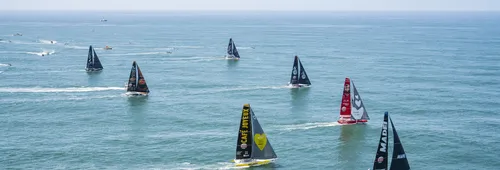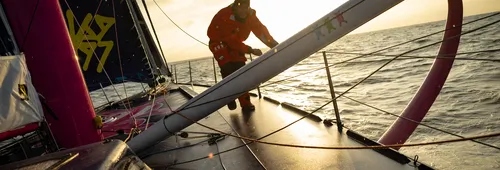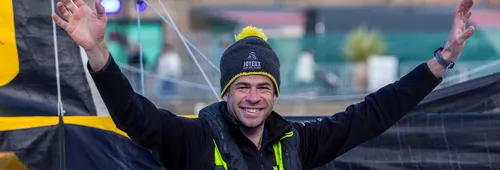


This will be Briton Mike Golding's third Vendee Globe solo round the world race. Not only is he still seeking overall victory, but the vastly experienced skipper would also like to simply complete the race enjoying a high level of satisfaction rather than moving on and wondering 'what if?' Luck has rarely played in his favour.
In the 2000 race he broke his mast within hours of the start and had to re-start eight days later, playing catch up.
In 2004-5 he fell badly behind but made up over 500 miles on the leaders and still managed to lead back into the South Atlantic before suffering a series of halyard breakages which ultimately cost him the lead. Approaching Les Sables d´Olonne when third place was pretty much his destiny, in the final hours of his circumnavigation, he lost the keel off Ecover. He went from being disappointed with third, to being pleased to make the finish at all.
Golding´s build up to this race with his new Owen Clarke designed Ecover 3 which was built in New Zealand, has not been easy. The 2007 Transat Jacques Vabre race revealed several issues with the ballast system and the engine, which were then followed by the need to build a new keel. Consequently Golding missed spring´s planned Artemis Transat race, and has not had as many racing and preparation miles as he would have liked. Finding and working with an English speaking shore team with top end IMOCA Open 60 experience has not been easy either.
" We are generally good in terms of the race start, but it has been tough with a relatively ´green´ team. The boat is fundamentally OK. We have been striving to that level of perfection but a reaching a sensible high standard. The other issue was what do we need to carry. And we came up with a workable list. Do you carry a spare rudder? We have done two Vendée´s without rudder issues, so what do you do?. We have come up with a workable spare rudder system and a list to make sure we go round." Explains Golding.
Approaching his third race, he notes that the weather information, its presentation and supply for this race is one of the biggest changes he has seen, so for, from last race to this:
" There is more information available. In the last Vendee we had a little more information available to us, and this time we have a system called Simboat which is from MeteoFrance and to be honest with you, it is complicated for me at the moment. The other trick to use all the information. I am sure that we have more information instantly to hand, easy to download."
"And you have a much more complicated boat. If you see our sails cross-overs, daggerboards, ballast in a crossover chart it would just blow your mind, forget it. And that is basically what the inside of your mind looks like after a few weeks! Spaghetti!"
With a more complex boat to sail, Golding´s two boat testing and tuning with Dee Caffari´s sister-ship Aviva, has been valuable and he is confident that he now has a good feel for what makes the boat quick:
" I have twigged the boat fairly quickly, and one advantage is it is an extension of what we had before. And for example in the two boat sailing we have done with the team, I think I really impressed Tim, our young lad sitting below doing all the electronics, every time the button moved into one sail change or a gear change, he would hear me calling it at the same time, so I think he was quite impressed by that, but then again if I can´t do that, then I´d be in a bit of trouble."
His assessment of the way the race will run serves a note of caution:
" I think there will be choices to be made, whether you stay with the fleet or make a move when you can. I tend to sail a fleet-orientated race, but you are really going to have to watch it because these boats are so quick, if a boat gets away you can be losing a lot of miles very quickly."
As one of the British pioneers who have blazed a trail on the Vendee Globe and other solo races, Golding is quietly pleased to see the high level of other British skippers set to compete, a new generation emerging:
" It is great to see so many British skippers are racing, it is pretty cool. And three of them have ´previous´ with me, Dee and Jonny - and Brian in the Jacques Vabre - so that is cool.
It is nice to think that some of them have been even a little bit inspired by what´s gone before, and someone like Dee, her choice path is identical, that is quite flattering. But really the great thing is not just that numerically, we have a good number of boats but they are a high calibre of boats. I think when 30 boats push off flat-out to sea, it is going to be a matter of time before boats start breaking. I reckon you will see a high level of attrition.
“And people will be saying ´this is terrible´……but the reality is the game moves on and everyone will push harder, plus the boats are more powerful."
" You do it (push too hard), of course you do it, but you have to meter it. Last time I fell off the back, but I never felt I could not pull it off. I never thought I could not pull it off."
Golding has regularly proven one of the fastest soloists in the Southern Ocean, holding both the solo Cape-to-Cape records from the 2004 race, sailing the Inidian Ocean, Cape of Good Hope to Cape Leeuwin in 14 days 21hours 30 seconds, averaging 13.7 knots and again in the Pacific from Cape Leeuwin to Cape Horn in 16 days 6 hours, averaging 12.8 knots, but he is rarely given to contemplate this attribute:
" Bizarrely I have never really thought about it too much. In the Challenge Race I was the fastest Cape-to-Cape, on the 2000 Vendee I was the fastest Cape-to-Cape, and in the last race I was the fastest Cape-to- Cape. I don´t actively do anything and I hear a lot of other guys flying A-Sails, and Code Sails and stuff. What I do have is a good ability to set up the boat to be very safe and fast, I know what to use between the configuration of the pilot and the set up of the sails to the optimum. And it is safe. And when I have got it right I have the ability to rest. With thirty knots across the deck I can rest, switch off, but wake up very quickly, and so I think I can be better rested, better able to respond.
He started the last Vendée Globe expecting and promising it to be his last, but here he is again:
" I think I knew I wanted to come back when I was finishing the last race. I did really enjoy the last race. It was so totally different from the 2000 race, playing catch up was not much fun and I always resented the fact that I was out of it. Unfortunately my chances of winning are going down, not only because I am getting older, but the standard of the fleet is going up. I think I have improved my game."
" My big fear for this race is breakage, particularly unnecessary breakage, something we could have done something about, because the worst thing with this kind of project where you try to cover off every eventuality, and choices about things, the worst thing is something happens that you have thought about and made a decision. That is a worse fear than ice-bergs. And funnily enough it is more likely to happen."
And now, back in Les Sables d´Olonne, he remarks on the unique challenge of the race, and the Vendée welcome:
" I think there is nothing else to compare to the start and finish in Les Sables d´Olonne. It is just phenomenal. The atmosphere is just amazing. When you are finished the reception is as good when you are first, third or last. They celebrate everyone. It is still an enormous challenge. The boats may have got glitzier, the sponsors bigger, it is a unique combination of adventure, sport, corporate involvement, national pride, it really does have everything. I think it really is unique. The down side of it is that it only happen once every four years. From a media perspective it is hard to keep the ball rolling."
Golding´s build up to this race with his new Owen Clarke designed Ecover 3 which was built in New Zealand, has not been easy. The 2007 Transat Jacques Vabre race revealed several issues with the ballast system and the engine, which were then followed by the need to build a new keel. Consequently Golding missed spring´s planned Artemis Transat race, and has not had as many racing and preparation miles as he would have liked. Finding and working with an English speaking shore team with top end IMOCA Open 60 experience has not been easy either.
" We are generally good in terms of the race start, but it has been tough with a relatively ´green´ team. The boat is fundamentally OK. We have been striving to that level of perfection but a reaching a sensible high standard. The other issue was what do we need to carry. And we came up with a workable list. Do you carry a spare rudder? We have done two Vendée´s without rudder issues, so what do you do?. We have come up with a workable spare rudder system and a list to make sure we go round." Explains Golding.
Approaching his third race, he notes that the weather information, its presentation and supply for this race is one of the biggest changes he has seen, so for, from last race to this:
" There is more information available. In the last Vendee we had a little more information available to us, and this time we have a system called Simboat which is from MeteoFrance and to be honest with you, it is complicated for me at the moment. The other trick to use all the information. I am sure that we have more information instantly to hand, easy to download."
"And you have a much more complicated boat. If you see our sails cross-overs, daggerboards, ballast in a crossover chart it would just blow your mind, forget it. And that is basically what the inside of your mind looks like after a few weeks! Spaghetti!"
With a more complex boat to sail, Golding´s two boat testing and tuning with Dee Caffari´s sister-ship Aviva, has been valuable and he is confident that he now has a good feel for what makes the boat quick:
" I have twigged the boat fairly quickly, and one advantage is it is an extension of what we had before. And for example in the two boat sailing we have done with the team, I think I really impressed Tim, our young lad sitting below doing all the electronics, every time the button moved into one sail change or a gear change, he would hear me calling it at the same time, so I think he was quite impressed by that, but then again if I can´t do that, then I´d be in a bit of trouble."
His assessment of the way the race will run serves a note of caution:
" I think there will be choices to be made, whether you stay with the fleet or make a move when you can. I tend to sail a fleet-orientated race, but you are really going to have to watch it because these boats are so quick, if a boat gets away you can be losing a lot of miles very quickly."
As one of the British pioneers who have blazed a trail on the Vendee Globe and other solo races, Golding is quietly pleased to see the high level of other British skippers set to compete, a new generation emerging:
" It is great to see so many British skippers are racing, it is pretty cool. And three of them have ´previous´ with me, Dee and Jonny - and Brian in the Jacques Vabre - so that is cool.
It is nice to think that some of them have been even a little bit inspired by what´s gone before, and someone like Dee, her choice path is identical, that is quite flattering. But really the great thing is not just that numerically, we have a good number of boats but they are a high calibre of boats. I think when 30 boats push off flat-out to sea, it is going to be a matter of time before boats start breaking. I reckon you will see a high level of attrition.
“And people will be saying ´this is terrible´……but the reality is the game moves on and everyone will push harder, plus the boats are more powerful."
" You do it (push too hard), of course you do it, but you have to meter it. Last time I fell off the back, but I never felt I could not pull it off. I never thought I could not pull it off."
Golding has regularly proven one of the fastest soloists in the Southern Ocean, holding both the solo Cape-to-Cape records from the 2004 race, sailing the Inidian Ocean, Cape of Good Hope to Cape Leeuwin in 14 days 21hours 30 seconds, averaging 13.7 knots and again in the Pacific from Cape Leeuwin to Cape Horn in 16 days 6 hours, averaging 12.8 knots, but he is rarely given to contemplate this attribute:
" Bizarrely I have never really thought about it too much. In the Challenge Race I was the fastest Cape-to-Cape, on the 2000 Vendee I was the fastest Cape-to-Cape, and in the last race I was the fastest Cape-to- Cape. I don´t actively do anything and I hear a lot of other guys flying A-Sails, and Code Sails and stuff. What I do have is a good ability to set up the boat to be very safe and fast, I know what to use between the configuration of the pilot and the set up of the sails to the optimum. And it is safe. And when I have got it right I have the ability to rest. With thirty knots across the deck I can rest, switch off, but wake up very quickly, and so I think I can be better rested, better able to respond.
He started the last Vendée Globe expecting and promising it to be his last, but here he is again:
" I think I knew I wanted to come back when I was finishing the last race. I did really enjoy the last race. It was so totally different from the 2000 race, playing catch up was not much fun and I always resented the fact that I was out of it. Unfortunately my chances of winning are going down, not only because I am getting older, but the standard of the fleet is going up. I think I have improved my game."
" My big fear for this race is breakage, particularly unnecessary breakage, something we could have done something about, because the worst thing with this kind of project where you try to cover off every eventuality, and choices about things, the worst thing is something happens that you have thought about and made a decision. That is a worse fear than ice-bergs. And funnily enough it is more likely to happen."
And now, back in Les Sables d´Olonne, he remarks on the unique challenge of the race, and the Vendée welcome:
" I think there is nothing else to compare to the start and finish in Les Sables d´Olonne. It is just phenomenal. The atmosphere is just amazing. When you are finished the reception is as good when you are first, third or last. They celebrate everyone. It is still an enormous challenge. The boats may have got glitzier, the sponsors bigger, it is a unique combination of adventure, sport, corporate involvement, national pride, it really does have everything. I think it really is unique. The down side of it is that it only happen once every four years. From a media perspective it is hard to keep the ball rolling."