

Vendée Globe

Summary of the weather in the 2008-2009 Vendée Globe

Summary of the weather in the 2008-2009 Vendée Globe
© MICHEL DESJOYEAUX / FONCIA / Vendée Globe
March 08. 2009

As the Vendée Globe comes to an end, it is time to look back at this sixth edition and today, we examine the weather faced by those taking part in the 2008-2009 Vendée Globe.

North Atlantic, strong upwind conditions, then downwind sailing in the trade winds
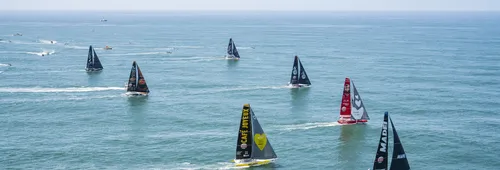
Living up to its reputation in November, a cold front passed across the Bay of Biscay, just as the thirty competitors set out from Les Sables d'Olonne. After the first hour of the race in rather light winds (9 to 13 knots), the conditions rapidly deteriorated. The gales resulting from the cold front (force 8 with gusts up to 45 knots) and very heavy, crossed seas made the first 36 hours of the race very difficult. Getting out of the Bay of Biscay upwind is always tricky. It was only once past Cape Finisterre in north-north-westerly winds and slightly calmer seas that the competitors were able to step up the speed, as they moved to downwind sailing.
However, before picking up the north-easterly trade winds, they had to tack westwards to get around to the south of the Azores high. There was then a long stretch on the port tack more or less down to the Cape Verde Islands. The trade winds, fairly favourable at between 15 and 25 knots allowed the competitors to achieve some very high peak speeds. But the favourable zone was quite narrow between the influence of Africa on the east and a ridge of high pressure with lighter winds to the west that some got too close to. The North Atlantic offered more or less what we would expect from a weather perspective.

The Inter-Tropical Convergence Zone, all or nothing
To the south of the Cape Verde Islands, the competitors have to cross the zone where the north-easterly trade winds in the Northern Hemisphere meet the south-easterly trade winds in the Southern Hemisphere. In general, where these two zones meet, thundery squalls permanently develop alongside calm zones. The ITCZ, living up to its reputation, shook up the rankings, as the boats passed through. The leaders had to cross it twice in fact, as it moved south after they had managed to cross it. Few thundery squalls developed and calms tended to dominate.
Those following on behind were treated to a more favourable crossing as the ITCZ moved back to the north, making it easier to cross with just a few local squalls and only a few calm zones. For those left behind, the ITCZ stabilised and a lot of thundery squalls developed with gusts in excess of 40 knots. The Doldrums will always be a tricky zone with frequent weather changes, which happen very quickly and are difficult to predict more than a few days in advance.

The South Atlantic, upwind in the trade winds and then strong downwind conditions
While the North Atlantic respected the usual weather scenario, that was not really the case for the South Atlantic. The Saint Helena high collapsed and moved towards South Africa while occasionally building again in spurts from the west. It was only after two new highs formed off the coast of Argentina that the high pressure area ended up settling around the island of St. Helena. But during that period, none of the thundery lows forming off Brazil allowed the gates to open towards the Cape of Good Hope. So there were no short cuts for the competitors forced to sail upwind from the Equator right down to the coast of Uruguay. It was only at 37 degrees South that the competitors at the front were able to turn left. This trajectory, which was made so much longer than those sailed in previous races in the South Atlantic, explains why the times to the Cape of Good Hope were longer in this race.
However, even this left turn was not the simplest of affairs, as it had to be adjusted due to a ridge of high pressure, which led some competitors to get too close to the high and see their speeds drop off, before, during and after this left turn.
The second half of the fleet with the competitors that set out from Les Sables d'Olonne after a return to harbour, benefited from slightly easier conditions, as the high moved slowly north-eastwards enabling them to take a shorter route to the Cape of Good Hope.
The route eastwards could finally begin in the disturbed westerly flow in the Southern Hemisphere. This meant a rapid entry into the Roaring Forties with a decent airstream to the longitude of Cape Agulhas. The fronts passed over the fleet fairly quickly, but the average wind remained below 40 knots. So the route eastwards began rather gently for the first two-thirds of the fleet. The final third experienced the arrival of two thundery lows coming from Brazil. These two active systems were accompanied by winds gusting to 50 knots.

In the Indian Ocean, the conditions steadily worsened
The move eastwards was fairly fast in the disturbed flow, with the gaps over the tail-enders widening more quickly. The leaders regularly benefited in the Indian Ocean from conditions that were easier to handle than for those at the rear. The daily averages were frequently above 400 miles thanks to winds that were usually blowing between 25 and 35 knots. An alternating pattern of troughs and ridges made the wind swing between the NW and SW. Several severe gales (force 9) associated with 6-8m high waves passed over the whole fleet between Africa and Cape Leeuwin, causing damage on several boats. Only a handful of competitors managed to get through the Indian Ocean in fairly favourable conditions. All of the others had to deal with a ridge of high pressure directed north-south with light winds slowing them down considerably. But the most dangerous situation was the arrival of storms (force 10), which managed to form in the South Atlantic and reach the tail-enders as they approached the Kerguelens. The winds associated with this low reached an average of 50 knots with gusts of 80 knots. The seas became heavier and heavier and were often crossed. While average wave height reached between 5 and 7m, in the most active systems, you could find waves of 10 to 12 m. They had to move northwards to leave these violent winds pass further south before thinking of the race and getting back on a shorter route in the Furious Fifties.

The Pacific, a violent storm for the leaders and a high for the tail-enders
After passing Tasmania, the leading group including Veolia, Foncia, VM Matériaux and BT passed the longitude of New Zealand and prepared to face one of the most violent systems in this round the world race. A low was forming to the north of New Zealand and deepening rapidly to move in from the north west across the trajectory taken by the leaders. The low then settled in the South Pacific between 55S and 60S and moved slowly eastwards. At the height of its development, this system would occupy more than half of the South Pacific. It was on the northern edge of this huge system that the leaders would sail towards the final Ice Gate off Chile. This violent storm (force 11 Beaufort) generated 50-55 knot winds gusting to between 70-80. In the north west quadrant of the system, the seas were particularly difficult to deal with with, as there were 8-12 metre high waves on top of a swell predominantly from the south west, but with a secondary swell from the north west. It was in these difficult conditions that Sébastien Josse's BT suffered major damage, when she was knocked down and Paprec-Virbac 2 suffered more damage to her steering system, which Jean-Pierre Dick had already repaired several times, forcing both of them out of the race. Slightly further back, PRB and Brit Air did not experience such violent winds, but nevertheless had to deal with the heavy seas whipped up by this low and it would take them several days to get around this area.
Behind, Roxy, Safran, Pindar, Aviva and Akena were in different weather systems from Cape Leeuwin right across to New Zealand. They were separated by a high-pressure area, which stopped them from stepping up the pace. This high prevented the small thundery lows that formed over the coast of Australia from moving eastwards. Thus, there were many of them disturbing the progress of the competitors producing at times winds between 35 and 45 knots with gusts between 55 and 65 knots creating permanently heavy seas. The competitors further back gradually entered this system a week later.
For those in the middle of the fleet, the Pacific crossing took place in classic conditions with a disturbed westerly airstream with several lows moving in from the west to the south of the trajectory taken by the boats. However, for the four tail-enders, the crossing was rather different, as these boats experienced an upside down configuration with highs to the south and lows to the north. This configuration meant sailing upwind for almost a week for Fondation Ocean Vital and for Nauticsport-Kapsch in the Western Pacific.

The climb back up the South Atlantic, a tricky stretch
Rounding the Horn marks the start of the climb back up the Atlantic, but this does not mean the end of the difficulties. This was seen by all of the competitors still in the race. Between Uruguay and the southern tip of Tierra del Fuego, lows develop very quickly and can move very quickly eastwards or south-eastwards. On top of that, they had to count on the fronts associated with the lows circulating in the Furious Fifties, which can stretch out to the north of the Falklands. Between these disturbed lows, highs can stay in place for several days blocking the route with ridges of high pressure and light winds.
To deal with the various systems, which can be found in this region, the boats need to get around the high via the east and the lows via the west avoiding the very light winds in the centre of the high and the strong winds on the edge of the lows. The lows that develop in this region are frequently accompanied by winds gusting between 65 and 80 knots. This means the skippers have to be particularly cautious and vigilant. The configuration only rarely allowed them to cross this region easily by staying on the right side of the systems. The three frontrunners nevertheless benefited from slightly more favourable conditions than those following on behind, to the extent that the huge thundery low that they had to get around off Uruguay was fairly well organised and fairly stable. On the other hand, all the other competitors had to deal with between one and three active cold fronts between Cape Horn and the north of the Falklands, then a mass of thundery clouds spread out over several hundred miles off the coast of Southern Brazil. Once out of this area of intense weather, the sailors had to sail in the east to south-east trade winds coming from the St. Helena high. These fairly strong trade winds (15/20 knots) for the frontrunners dropped off to 10/14 knots after that.

Inter-tropical convergence zone (ITCZ) and the north-easterly trade winds
The second voyage through the Doldrums was easier than the first to the extent that the competitors arrived from the west and so crossed this zone in a place where the calms are not as wide. Nevertheless, the ITCZ remains fairly unreliable from one day to the next and while some were not really slowed down, others experienced thundery squalls and flat calms. The idea in getting across this zone is to come out on the other side as far east as possible to sail upwind in the NE'ly trade winds. These were fairly strong (20/25 knots) for all the boats. This stretch of upwind sailing was therefore fairly tricky particularly as the sea remained heavy throughout the period (average wave height 2.5 to 4m). The relative strength of the NE'ly trade winds and the relative weakness of the SE'ly trade winds partly explain the position of the ITCZ, unusually far south. In January and February, the ITCZ moved between the Equator and 2°S, whereas usually it is usually between the Equator and 2°N (to the west of 25°W).

The North Atlantic, reaching the disturbed westerly airstream
Before heading for Les Sables d'Olonne, the boats need to reach the disturbed westerly airstream on the northern edge of the Azores high. This is indeed what the frontrunners experienced. Some got around the high via the west to take advantage of the downwind sailing offered by the SW'ly winds (Foncia, Veolia, Safran, Pindar, Aviva, Akena), while others chose a shorter route, but a riskier one close to the centre or the east of the high (Brit Air, Roxy). But while the first two managed to reach the Bay of Biscay thanks to this airstream, that was not the case for those that followed. A few days after Brit Air finished, a change in the weather system affected Western Europe and the near Atlantic: a high settled over the British Isles regularly generating north-easterly winds in the Bay of Biscay and even beyond. It was this configuration that all of the boats about to finish faced from Roxy to Toe in the Water.

Even if the competitors are all taking part in the same race, they did not all have to deal with the same weather systems because of the rapid changes in the weather as the boats sailed around the world. For example, the final two competitors experienced between two and three times as many gales (Force 8 Beaufort) as the first two boats. One competitor (Pindar) had to shelter off los Estados Island off Tierra del Fuego for a whole day to leave a violent storm go by. But fortunately the most dangerous system over the race course during this period passed over the fleet before reaching its climax. The storm on 24th January produced gusts close to 100 knots in the south of the Bay of Biscay, but the boats were still far enough off the coast not to have to deal with these winds. This illustrates perfectly the weather data, which proves that during the Vendée Globe, the strongest winds are most likely to be found in the north-east Atlantic.

Sylvain Mondon and Richard Silvani
Météo-France
 

Book your stay in Vendée Vendée Globe Junior CCI Vendée Vendée Expansion Becoming a partner Sign up for the Vendée Globe newsletter 2012 trailer Official Poster 2012 - 2013