

Mike Golding: "A three-dimensional chess game"
Articles |
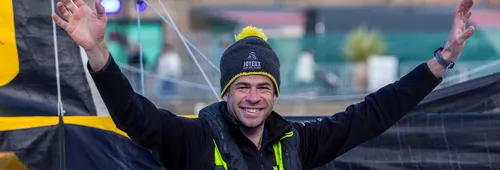
One day, one skipper - Highly experienced British skipper Mike Golding (Gamesa) is coming back for his fourth consecutive Vendée Globe. A regular race competitor who does not hide his ambition. He tells us his story very smoothly and easily.
© Vincent Curutchet / DPPI
So Mike, how do you feel?
Good. Looking forward to get and going. Stop doing all of this. I’m excited.
What are your best memories so far as a skipper?
Well it’s complicated to say. One of the biggest pleasures in my career has been obviously finishing the 2004 Vendée Globe in 3rd place, which was a good result. Particularly, as 50 miles before the finish, the keel had fallen off the boat and I was very lucky to finish even more in 3rd place. But also, sailing with crew around the world was one of my best memories. I did it twice and finished second the first time and first the second time. I really enjoyed it. It was a great experience, a great collective experience, very different from the solo sailing. These round-the-world races have always been a great pleasure to me.
On the opposite, what would be your worst memory?
It’s hard not to think of the last Vendée Globe and being dismasted underneath Australia. We were leading the race in a strong position. It’s not easy to go out of a race like that. I was very disappointed, that’s an understatement. To the point I moved away from IMOCA for two years and I did only extreme 40’ catamaran sailing which refreshed my “modjo” (laugh). But then quite quickly this Vendée Globe started to come closer and I realized I had to do it again and I had to have another go. We put together a very nice project in two years with Gamesa. With still have our old boat but heavily modified and changed to improve it both in terms of performance and reliability. And for myself, I’ve spend the last two years concentrating only on this project, so I feel in a good place to make a good competition.
How is the relation with your sponsor Gamesa?
We signed with Gamesa in the middle of last year. We’ve been doing many things, even a world tour, went to all different factories in China, in Brazil, in the USA. We’ve been talking to all the employees trying to engage them in the project. We also integrated team members into our team and they came with us to Le Havre, Saint Barth…
It has been economically very difficult with the Spanish sponsor, so I am very delighted they’ve continued to support the project, to be honest. I think with a sponsor like Gamesa, being in the wind turbines, there is a perfect synergy between what their manufacture and what we are doing as a sport. And also the values that we hold are very important and are the same values the company wishes to promote. There is a very positive synergy there.
Where did you get this passion for sailing?
I’ve sailed since I was a young child, nine years old. When I was a teenager, I sailed offshore with my family and then later, when I left college, I sailed mostly round the world on a small catamaran. I learnt with a very good teacher of navigation. I learnt to navigate traditionally with a sextant. I was always very passionate about it.
I was a fireman for eleven years, but I was always sailing and always sailing at quite high level. At thirty, I had the opportunity to turn my passion into my profession. When the opportunity arose, even if I loved my job as a fire officer, I could not turn down this occasion. It was a great opportunity, I never looked back. I have actually a fantastic sailing career already. Hopefully we still have some highlights still to come.
« It’s definitively a way of life »
What does the life of yachtsman look like?
Well, to be honest, running one of these boats is like running a small business. It’s the same as any other small business, with the same responsibilities. You have staffing, you have finance, etc. You have to run it professionally to be able to be efficient. From a day to day perspective, you’re just running a small company, with a small team, which you have to keep motivated and administrated correctly. From a sporting perspective, you’re developing the boat which is a technologically complicated device involving a lot of different technologies. From a personal level you have to prepare yourself physically. All three things have to be done in conjunction.
I think all of the modern teams now are being very professional in their approach. The teams that work for them are very experienced. There are twenty skippers but there are probably one hundred or one hundred and fifty support team members behind these twenty skippers supporting the activity and making the actual race possible.

How do you manage your family life?
I leave on the coast, I am married with one child, a nine year old boy named Soren. Our offices are in Southampton and most of my team lives there. We work a normal week like anyone normally does. But when there is an event we have to do more than that, we have to work over the week end, this time over Christmas. It’s definitively a way of life. But it’s not so different from regular business…
Can you describe the race in your own words?
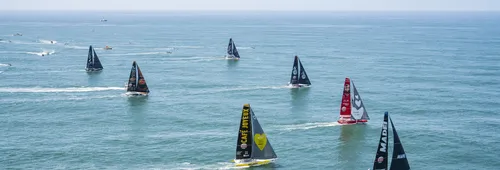
It’s a very simple concept: to sail single-handed, nonstop without assistance around the world. But at the same time it’s extraordinarily complex to do it. Because it’s complicated to have the right equipment, to be competitive, to have the right team around you to make it happen efficiently. I have described the race before as a three dimensional chess game: the weather, the technology, the physical act of sailing the boat (which includes the strategy, tactics, etc.). You have to win on every level if you want to win the race. It’s a complicated game but that’s what makes it fun.
Are there some places you cannot wait to meet again?
Cape Horn for example, I can’t say I can’t wait because you never know what you are going to get. You get Cape Horn on a good day, it’s an amazing place, and it’s a fantastic place to be. But if you get it on a bad day you wouldn’t want to be there (laugh)… It’s quite the same with other places. So I can’t identify a specific place. But it’s always a pleasure in November when you leave Les Sables d’Olonne whatever the weather is like, you know that the first thing that is going to happen is that the weather is going to get warmer. You have the flying fishes, the dolphins, the whales, the blue water, the sun comes out and it gets warm. It’s always a pleasure.
« I’d like to do better than third »
Do you have any fears for this coming Vendée Globe?
You never know what is going to happen in the Vendée Globe. Last time when we began the race we didn’t know my mast was going to fall over. Basically you have all the fears and also all the anticipation of the enjoyment that can be lived if you complete the race successfully. So it’s a mixed emotion. I know enough to know it doesn’t always work out perfectly but I also know it can, and be a beautiful experience.
© Mark Lloyd / DPPI
Unfortunately, you had to withdraw during the last Vendée Globe, are you revengeful?
Not revengeful, but we work in a technical sport and things can break. When you’ve done as much sailing as I’ve done then you realize this. So, you have to put that behind you and go forward. Am I revengeful? No I’m not revengeful. I have enjoyed every single Vendée Globe experience and I plan to enjoy this one. But for sure, I’d like to do better than third which is my best result in the Vendée…
Two places left…
Two places left, that’s my goal, whether I can do it, that’s the question… We will only find out in a few weeks time…
One particular thing about the Vendée Globe is that you race in solo and you are going to spend Christmas and New Year Eve by yourself. How is it going to feel?
To be honest, Christmas day is just another day on the boat, there is no big change. When you go on a big race like this, you are committed to that race and everything else is put on the side. Obviously I’ll be looking forward to phone calls home to speak to my wife and my child. But really my approach is to do the race and to be safe, to do as well as I can do.
A three-month race is a long time, how do you deal with loneliness?
I have some books, some films, and some music. But to be honest on a boat these days, you nearly always have some work to do. Anyway, I’ll read, watch a movie maybe, I have music going on the boat quite a lot. It helps me to break the monotony, because like a lot of things, even the process of sailing on these boats is quite repetitive. At the beginning it’s very exciting but soon it becomes almost mundane but you need to keep your focus even when it’s mundane because this is where you are in danger.
« I can keep it up for 90 days, what you need to do for the Vendée »
There are great crossing points in the Vendée Globe, how do you feel before reaching them?
The Vendée Globe is a very long race and the only way to manage such a long thing is to break it into small pieces and deal with each thing as it comes. Of course there are big crossing points and when you pass one of them, you check your list and move on to the next one. That is your focus. But to do this you have to break your race in many more points than those big points. Always you are looking toward to your last dating point which is Les Sables d’Olonne. Actually it’s the bars in Les Sables d’Olonne (he laughs).
It seems like time is very important in the way you manage your race?
Yeah, not really time, but objectives. You know, when you start the Vendée and you are thinking you are going to sail for 76 days or more, it drives you crazy. Each day must be taken as it comes, sometimes even each hour. For example, when you are in a big storm, you have to go hour by hour. I really manage my race like that.
© Vincent Curutchet / DPPI
As a skipper, do you feel strongly about the respect of the environment and sustainable development?
Totally. My sponsor Gamesa is a wind power company. We are getting our power onboard from hydro generators, solar panels, wind. But we also do have an engine and we can use this to charge batteries. In a race like the Vendée, we won’t put anything into the ocean; we do the minimum damage wherever we go. We’ll never put waste into the ocean. Even more we’ve spent thousands of euros to make the boat lighter. We feel very strongly about the respect of the environment because we see directly the effect of not doing it. In the middle of the ocean, everyone knows that now, there are areas which are full of waste. Sailing is a clean sport, is an environmentally sound sport and we need to promote that. We need to be as good as what we say.
What kind of animals do you often see on a race like that?
You begin with flying fishes, dolphins, perhaps whales and sharks. As you go further south you start to see some sea birds, albatrosses, seals, penguins, whales, dolphins. Generally most of the wild life you see is close to the shore not offshore. The only things you see when you are really offshore: albatrosses. They are everywhere in the South.
What animal amazed you the most?
I think they all amazed me. Anyway, the albatross is amazing because it’s a bird that lives in the wind; it stays in the sky for much of its life. For an albatross, flying looks so effortless. It’s crazy.
In your everyday life onboard, how do you manage food, hygiene and sleep?
Probably the same as most guys. I have freeze dried food mostly. Sleep is very short. I take very short naps; generally no more than hour but often much less, often like 20 minutes or whatever. But I have trained myself to be quite efficient. For me it’s ok. I can do it quite sustainably. So you feel a little bit tired, all the time, but only like a little bit. It’s completely sustainable; I can keep it up for 90 days, what you need to do for the Vendée.
Sometimes skippers can have hallucinations. Did you have some during your career?
No! Because I have three golden rules: you sleep before you are tired, you eat before you are hungry, and you change your clothes before you are cold. If you do all three, you are ok. If you miss one, you are in trouble (laugh).
You are not superstitious?
No, I’m not superstitious. Let’s say that my superstition is to have my list complete. Make sure that everything’s done. That’s the thing I need to have.
Romain Delaume