All news

Vendée Globe skippers: sleep and stress tracked in real time

After a Vendée Globe, some of the skippers’ biological markers resemble those of astronauts. Bioengineer Bérénice Charrez has built a system to track their bodies at sea.

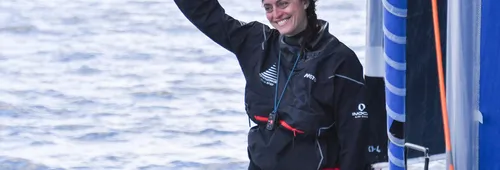
Bioengineer and sailor Bérénice Charrez smiles in an offshore racing workshop. On the workbench in front of her lie the onboard unit and the chest strap sensor of her system for monitoring sailors’ physiology in real time.

Striking results, from ocean to orbit

The comparison may sound bold, but it is grounded in science. After the last Vendée Globe, a study led by the IMOCA Human Performance Project found physiological changes on a scale rarely documented before. IMOCA is the class of 60-foot monohulls raced in the Vendée Globe. Muscle wasting, balance problems, too little sleep and poor-quality rest: the picture was already worrying. Saliva and urine tests revealed far more.

“We see changes in the immune system, hormonal disruption and oxidative stress, at levels fairly close to those seen in astronauts. Some are almost pathological,” says Bérénice Charrez. It is a very different picture from the one many people have of skippers, sitting fairly still aboard their monohulls. “It’s far more brutal than people think. It’s not just about losing your balance or muscle mass. It genuinely affects the metabolism.”

The comparison feels especially timely, coming a few weeks after French astronaut Sophie Adenot returned to Earth. She spent nearly eight months aboard the International Space Station. The mechanisms are of course different. Astronauts live in microgravity; sailors endure impacts, vibration, constant motion and lack of sleep. But the body responds in ways that are similar enough to open up new lines of research.

“I think sailors should be monitored more closely, especially through blood biomarkers, so we can understand what’s really happening in their bodies.” A scientific paper on the findings is in preparation. They raise a far more practical question: how do you protect sailors better without compromising on performance?


We’ve reached the point where the weak link is the human on board.

Bérénice Charrez
bioengineer

The boat, the sailor and everything in between

That is exactly what Bérénice Charrez has been working on for the past eighteen months. Forget the image of a simple fitness tracker. At the heart of the system, a central unit collects and synchronises three types of data: from the sailor, from their surroundings and from their boat.

A chest strap or armband measures physiological data via an onboard Bluetooth network. Other sensors record temperature, noise, light, motion and impacts. The navigation instruments add points of sail, manoeuvres and sea conditions.

The aim is not to pile up numbers, but to understand how they interact. “My hypothesis is that if you study the human in isolation, you miss a big part of the story. Sailors are in extreme conditions. You have to measure those conditions to understand why the body reacts the way it does.”

The real value lies in that cross-referencing. A high heart rate does not mean the same thing after a hard gybe, in a sweltering cockpit or after hours on watch. Poor recovery can come from the state of the sea as much as from the heat or the noise.

The system also runs entirely on board, with no internet, phone or cloud. Sailors view the results on their navigation computer, through a dedicated interface.

One of the first applications is automatic detection of rest periods. The machine-learning algorithm behind it was trained on nearly 10,000 naps recorded since the last Vendée Globe. “We can detect sleep, partly assess its quality, and calculate energy expenditure, stress levels and hydration needs. We’re also working on cognitive aspects, especially alertness, but those models still need validating.” The tool also tracks the risk of hypothermia and hyperthermia. A mass of raw measurements becomes information sailors can actually use.

A hand points at the navigation computer screen inside an IMOCA. The physiological monitoring interface displays the food intake module: calories consumed during the day and a choice between snack, half meal and full meal.

Understanding the body to go further

An extra dashboard would be of little use if sailors could not act on it. First up: nutrition. Data from the last round-the-world race showed that some competitors burned up to 5,000 calories a day, without always eating enough to make up for it. “Most of them don’t eat enough. We can already remind them of the basics: eat properly, drink enough, take electrolytes.”

Sleep is next. Rather than imposing a schedule, the system could help each sailor find when they recover best and plan around the weather. “If a skipper knows they sleep better at certain times, or that a big weather system will hurt their recovery, they can adjust based on objective data they simply don’t have today.”

Longer term, the researcher hopes to build models that predict how the body will respond to conditions ahead. She also sees value in pooling the data: the more boats are equipped, the more accurate the algorithms become, for everyone. Via satellite, some data could also reach race doctors in an emergency, to better support a sailor alone at sea. Fans could even follow simplified indicators, opening up a side of the race that has so far stayed hidden.

Above all, this signals a shift in mindset. For decades, designers and technical teams have pushed IMOCA boats ever further. The next breakthrough may not come from design offices alone. “We’ve reached the point where the weak link is the human on board. I think that’s where the future of offshore racing lies too: extending careers, protecting sailors’ health and keeping them competitive for longer.”

Safety, endurance, longevity: the potential benefits go far beyond the next finish line. Boats have long had electronics that flag their slightest weakness. Their skippers are now starting to get the same attention. After all, in a sport built on pushing your limits, you first need to know where they are.

[Bande-annonce] « Vendée Globe, Seuls autour du monde »

Share this article

Latest news