

Nico D’Estais, the joyful story of the skipper with the yellow boat
THESE SKIPPERS AIMING FOR VG2028 - Part 3 of 5.
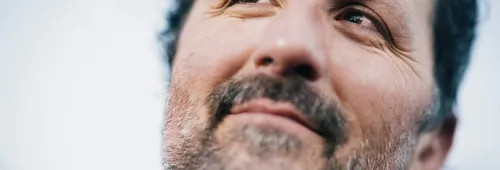
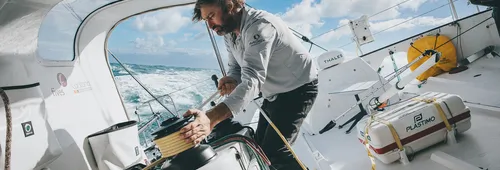
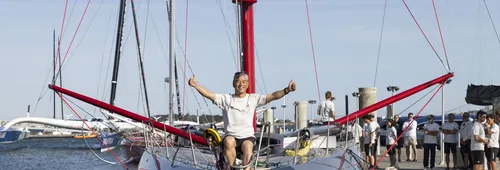
A former business strategy consultant in Paris, Nico D'Estais swapped his suit and tie for a sailing jacket several years ago, in order to focus on ocean racing. After two Mini-Transat races and four years in Class40, he is taking a new step forward by entering IMOCA in 2025, bringing him a little closer to a dream he has had since childhood: to compete in the Vendée Globe. At the helm of a boat with an exceptional history, he is also leading a unique, committed and socially responsible project promoting the Café Joyeux cause.

Vendée Globe :
Can you introduce yourself?
My name is Nico, I am 34 years old, and I am the skipper of the IMOCA Café Joyeux. I turned my life around four years ago to become a skipper: before that, I was a business strategy consultant in Paris. I started ocean racing in Mini, did two Mini-Transats, then sailed for four years in Class40. In 2025, I joined the IMOCA class.
Vendée Globe :
Where did your dream of competing in the Vendée Globe come from?
Since I was six years old I have dreamed of only one thing: competing in the Vendée Globe. From my very first experiences, sailing an Optimist, I already had this weird idea that one day I would compete in this race. It is the culmination of a lot of hard work, looking to realise a dream that has been with me for a very long time. Every day it is a joy to work as a sailor.
Vendée Globe :
What are your earliest memories of the Vendée Globe?
I have two very vivid memories.
The first dates back to 1998. We were living in Tokyo when I was a child and we went as a family to a conference given by Titouan Lamazou, winner of the very first Vendée Globe. My parents have no memory of it, but I remember it as if it were yesterday. That was when the seed for my Vendée Globe was first planted.
The second was Ellen MacArthur's finishl. After Tokyo, we moved to London. I was living there when she completed her Vendée Globe. I saw the images of her finish on television, probably on my way home from school, and I said to myself: OK, I want to be her when I grow up.
I've been lucky enough to see them both again since then. I was quite proud to tell them that it was thanks to them that I was where I am today... and I don't think they cared much (laughs).
Vendée Globe :
What does the Vendée Globe mean to you?
It's the greatest and most beautiful adventure on Earth. It's immense: you can't imagine a bigger playground than the planet itself—there are no interplanetary races yet (laughs).
I really like the idea that the globe is our playground: there are no limits like on a soccer field or a chessboard. The field of possibilities is immense, and it's up to us to find the best trajectory to get from point A... to point A, which is in itself a bit weird.
Vendée Globe :
Your boat has a very rich history. Can you tell us more about it?
Yes, the boat has a remarkable history. In 2024 it was previously owned by Benjamin Ferré and before that by Clarisse Crémer in 2020. In the sail locker, there are still some words written for Clarisse: for example, a ‘T’ with a heart, signed by Tanguy (Le Turquais, her husband). There are also some short messages for Benjamin.
There is also a beautiful cardinal buoy designed when the boat belonged to Paul Meilhat for the 2016 Vendée Globe — the same boat onwhich he won the 2018 Route du Rhum, and with which François Gabart won the 2012 Vendée Globe.
There are quotes from all walks of life, from Le Flambeau (a French series by Jonathan Cohen with cult catchphrases) to Jean d'Ormesson: ‘If you talk about roses, you must also talk about thorns.’
I keep all these little notes. They are part of the boat's heritage.
Vendée Globe :
The Café Joyeux project is pretty unique. Can you tell us about it?
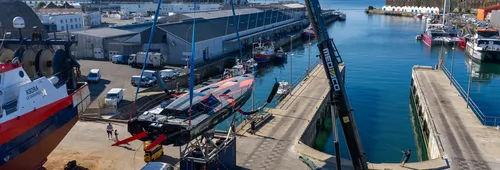
The boat is called Café Joyeux and it is completely yellow. The project is above all a communication campaign for Café Joyeux, a family of café-restaurants that employ and train people with disabilities.
There are now around thirty cafés in France and around the world, as well as a coffee brand. All profits from sales are used to finance the hiring - on permanent contracts - of new, soon-to-be joyfulteam members in these café-restaurants.
The boat is used to promote Café Joyeux, encourage people to visit the cafes and to sell more coffee. It is a virtuous, mindful project.
Café Joyeux itself does not contribute a single euro to the sporting project which is financed by partners. The most significant are Ibis, Nestlé and Castorama.
The project took on a new dimension with IMOCA, but the principle was already well established in Class40.
Vendée Globe :
What's your sporting news?
2025 was a year of discovery and learning to understand the boat.
2026 will be the year of solo sailing, which is no small feat: it's a big boat, with big sails and a tall mast!
My last solo race was two years ago, in Class40, during the Transat CIC.
The road to the Vendée Globe is a series of steps. Today, I would be unable to set sail on the Vendée Globe tomorrow. On this staircase, the step for 2026 is a very big one! I will be competing in the Vendée Arctique – Les Sables d'Olonne next June.