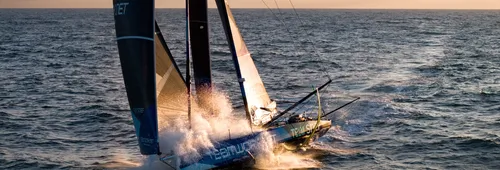
Race director of the Route du Rhum – Destination Guadeloupe, Francis Le Goff is adamant: there were “weather anomalies” during the famous transatlantic race. The first was the high pressure sitting off the coast of Brittany, which brought a start under brilliant sunshine and almost sent spectators into T-shirts, an oddity in November. The second was the absence of established trade winds. In short, the classic transatlantic route was all but ruled out: down the coast of Portugal, around the Canaries, then into the trade winds. So the race was fought out north of the great circle (the direct route). At those latitudes, it is colder and conditions are more extreme, with confused seas and strong average winds.
When the weather plays tricks
The Route du Rhum – Destination Guadeloupe served up a course as incongruous as it was unusual. The lack of trade winds forced the entire fleet to take a route north of the great circle in particularly gruelling conditions. The race was also marked by the violence of a tropical depression. What if these unusual weather patterns were to happen again? What would it mean for offshore racing and the Vendée Globe? We explain.

© Julien de Rosa / AFP
Going that far north is something I’d rarely done
« We had a weather pattern that was the complete reverse of the usual one,” explains Cyrille Duchesne, head of forecasting at Météo-Consult. “The fact that there was a depression instead of the Azores high explains the lack of trade winds, which normally form to the south of that high. »
A competitor in the race and already a two-time Vendée Globe participant, Maxime Sorel (Vaincre la Mucoviscidose) describes his surprise on discovering the weather situation before the start. . « Usually, when we run ensemble routings, there are always plenty of routes to the north and to the south, » he explains. . « This time, not a single route went south; they all sent us north. I’d never seen that. It felt like we were heading for the Grand Banks of Newfoundland. » « When we studied the routings, there was no southern route at all, » agrees Arnaud Boissières (April Marine). « Going that far north is something I’d rarely done!”

© Gauthier Lebec
And then, a tropical depression
In practical terms, the skippers had to forget about downwind sailing and deal with upwind conditions and the cold for more than a week. They had to head north and withstand demanding conditions, which partly explain some of the early retirements. It was an unprecedented course, and for good reason: in the previous twelve editions, conditions had never forced the entire fleet so far north.
But when the skippers finally began sliding south after passing the Azores, their troubles were not over. The cause? A tropical depression formed and swept across the whole fleet, including the IMOCAs. « What’s unusual is that these depressions normally pass on the Caribbean side, whereas this time they were right on the fleet’s route, » says Cyrille Duchesne.
« What was strange was that the tropical depression was stationary, it wasn’t moving, » Maxime Sorel continues. « We had to go all the way round it. » The skipper, despite his considerable experience, describes « a really strange atmosphere », with « an almost yellow sky, heavily charged with electricity, and a sea churned up in every direction ». « It was like a nightmare, » says Maxime.
Increasingly unusual weather phenomena
Francis
Le Goff
Race Director of the Route du Rhum - Destination Guadeloupe
Yet the skippers adapted and largely held firm, despite the accidents suffered by Jérémie Beyou (Charal) and Ambrogio Beccaria (Allagrande Mapei), who were both injured. The IMOCAs, new and older generations alike, proved their durability, even at the height of the storm. The winner, Corentin Horeau (MACSF), even showed that 60-foot monohulls can go toe to toe with the Ocean Fifty (50-foot multihulls). He crossed the line just two minutes after Basile Bourgnon.

© Francesca Clapcich
More broadly, Francis Le Goff says that « the weather phenomena we encounter are increasingly unusual, with very strong squall systems ». « In the end, climate change is becoming more and more visible, with every edition and every offshore race. » « Before, you had very settled situations, with well-established patterns, » adds Maxime Sorel. « Now it feels like things aren’t as simple as they once were. Everything seems a bit more complex. » For his part, Cyrille Duchesne explains that « these disrupted patterns are bound to become somewhat more frequent ». He attributes this to « global warming, with more humidity and more heat ». « It’s an important factor to take into account for the future. »
It could open up the game even further
Arnaud
Boissières
LA MIE CÂLINE
If transatlantic routes can be this disrupted, what could it mean for a round-the-world race like the Vendée Globe? « We can imagine that with similar conditions in the North Atlantic, routings would send us north at the start, up towards the Grand Banks of Newfoundland, » says Maxime Sorel. « If it’s impossible to go south, we’ll have to go north… Because otherwise the risk is being parked up for a week! » Arnaud Boissières sees it above all as a strategic challenge: « It could open up the game even further. In the end, that’s what we saw in the Route du Rhum: an outsider, Corentin Horeau, came through the fleet just when people least expected it. » Cyrille Duchesne backs up the sailors’ view: « We can imagine depressions moving a little differently, and the high being a little more mobile and less fixed. Here again, the usual patterns could be disrupted. »
These upheavals will affect the way strategies are built, and more besides. « It could also have an impact on the way boats are designed, » adds Arnaud Boissières. Whatever happens, sailors will always need precise knowledge of the conditions. To that end, the skippers in the next Vendée Globe will be able to take scientific instruments on board and deploy them during the race. The aim? To collect as much data as possible and understand the state and evolution of the climate and oceans as precisely as possible… And to let the sailors do what they do best: anticipate the conditions they will face during races as far ahead as possible.