All news

The Ocean

Point Nemo: where is the most remote place in the ocean?

At Point Nemo, the nearest land is 2,688 km away; space, just 400 km above. Vendée Globe skippers sail past it alone, days away from any help. Here is where it lies, and what it means on board.

point Némo
© Cartographie Vendée Globe

Friday 20 December 2024, somewhere in the South Pacific. Charlie Dalin (MACIF Santé Prévoyance), Yoann Richomme (PAPREC ARKÉA) and Sébastien Simon (Groupe Dubreuil) are closing in on a line no one can see. No lighthouse, no buoy, no island: just the longitude of Point Nemo on their screens.

Point Nemo is the place in the ocean furthest from any land. All around, 2,688 kilometres of water to the nearest shore, according to the US National Oceanic and Atmospheric Administration (NOAA). Above, the International Space Station, when it passes overhead, some 400 kilometres up. Below, around 4,000 metres of water, in the heart of the South Pacific.

The Vendée Globe, the solo, non-stop, unassisted round-the-world race, passes this way every edition, between New Zealand and Cape Horn.

Where is Point Nemo?

Coordinates, and nothing else

Point Nemo lies at 48°52.6′ South and 123°23.6′ West. Don't look for a rock or a beacon: it only exists on charts. Geographers call it the "oceanic pole of inaccessibility", the point in the ocean furthest from any coastline.

Three neighbours, all 2,688 kilometres away

Point Nemo has three neighbours, all at the same distance. To the north, Ducie Island, an uninhabited atoll in the Pitcairn group. To the north-east, Motu Nui, an islet off Easter Island.

To the south, Maher Island, off the coast of Antarctica. Point Nemo sits at the centre of this triangle of water. On the Vendée Globe course, it lies between New Zealand and Cape Horn.

A captain who shunned mankind

Point Nemo was only located in 1992. Hrvoje Lukatela, a Croatian-Canadian engineer, pinpointed it by calculation, without ever going there.

It takes its name straight from Jules Verne. Captain Nemo, in Twenty Thousand Leagues Under the Seas, shunned the company of men, and nemo means "no one" in Latin. It could hardly have been better named.

L'IMOCA SMA en chantier à Tahiti suite à l'abandon de Paul Meilhat
© Domenic Mosqueira / VG2016

Point Nemo: just how remote is it?

2,688 kilometres, six days at sea

Sailors measure distance in nautical miles: one mile equals 1,852 metres. The 2,688 km separating Point Nemo from land work out at around 1,450 nautical miles. At an average of 10 knots, or 10 miles an hour, it would take about six days to reach a coast.

And after those six days, there would be no one to greet you: none of the three nearest islands is inhabited.

Closer to astronauts than to anyone on Earth

At Point Nemo, space is closer than dry land. When the International Space Station passes over the area, its astronauts, some 400 kilometres up, become the nearest neighbours. After the other skippers, of course. And the comparison goes further: after a Vendée Globe, some of the skippers' biological markers resemble those of astronauts.

4,000 metres of water beneath the keel

Remoteness can also be measured vertically. Below Point Nemo, the seabed lies some 4,000 metres down. An IMOCA, one of the 60-foot (18-metre) monohulls raced in the Vendée Globe, sails over four kilometres of water.

Fifteen days for help to arrive

In the event of damage, help arriving by sea would take around fifteen days to reach a sailor. That is the estimate published by the Vendée Globe in 2024. Out here, the nearest neighbour is often a fellow competitor.

In 2024, those neighbours were many. According to the Vendée Globe, Point Nemo had never seen so many IMOCAs file past in so short a time.

At Point Nemo, damage hits harder than anywhere else. Paul Meilhat (SMA) learned this in his first Vendée Globe, in 2016. Then third in the race, he discovered a crack in his keel ram, the hydraulic system that cants the keel beneath the hull. The damage forced him to retire.

"At that point, I was in third place. Finding shelter was always going to be difficult. We found a solution: I diverted to French Polynesia. It took me about eight days to get there!" he told The Ocean Race in March 2023.

Eight days to reach shelter: that single figure sums up the geography of Point Nemo.

Explications sur le point Némo | Vendée Globe 2024

How does the Vendée Globe fleet pass Point Nemo?

A longitude, usually crossed to the south

For a skipper, "passing Point Nemo" means crossing its longitude: 123°23.6′ West. The route doesn't necessarily go through the point itself. Tracking data from recent editions shows the fleet very often leaving it to the north, depending on the weather.

In 2024, the leading trio were gybing some 300 miles south of the point. Gybing means changing tack by turning the stern of the boat through the wind. The three sailors had by then spent around forty days at sea.

Every edition, its own story

Every edition writes its own chapter at Point Nemo. On 30 December 2020, Clarisse Crémer (Banque Populaire X) celebrated her 31st birthday there, in the middle of the Pacific. In 2024, it witnessed a three-way battle. The day before the passage, Yoann Richomme was 47 miles behind Charlie Dalin, and Sébastien Simon 73 miles back, sailing without one of his foils. After nearly 40 days at sea, less than 75 miles still separated the top three.

To relive the fleet's passage in 2024, dive into our race report "Finding Nemo".

Next stop: Cape Horn

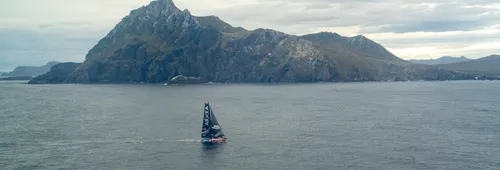
With Point Nemo behind them, the skippers head east. At the end of the South Pacific lies Cape Horn, the gateway to the Atlantic. In between, several more days at sea across an almost empty ocean.


At that point, I was in third place, he said earlier. It was obviously difficult to take shelter. We had found a solution, I had diverted to French Polynesia. It took me about 8 days to get there!

Paul Meilhat
Biotherm

What Point Nemo means for a skipper

Alone at sea, never alone in the adventure

On board, the skipper is alone. Ashore, Race Direction follows every boat day and night. So does each skipper's team, within the strict limits of an unassisted race.

Point Nemo and the 2028 Vendée Globe

November 2028, Les Sables d'Olonne. A new fleet will set off around the world, and Point Nemo will be waiting somewhere between New Zealand and Cape Horn. How close will the fleet pass? The weather will decide.
Until then, the race goes on. Follow the candidates for the 2028 Vendée Globe: some will discover Point Nemo for the very first time. We will update this page during the race.

Your questions about Point Nemo

Vendée Globe :

What is Point Nemo?

It is the point in the ocean furthest from any land. Geographers also call it the "oceanic pole of inaccessibility".

Vendée Globe :

Where is Point Nemo?

In the southern Pacific Ocean, roughly halfway between New Zealand and South America. No island or coastline lies within about 2,688 kilometres of it.

Vendée Globe :

What are Point Nemo's coordinates?

48°52.6′ South and 123°23.6′ West, in degrees and minutes. In decimal degrees, the format used by mapping apps, that is approximately -48.88 and -123.39.

Vendée Globe :

How deep is the ocean at Point Nemo?

The seabed lies at around 4,000 metres. Several kilometres of water separate the surface from the bottom.

Vendée Globe :

Is Point Nemo dangerous for sailors?

The spot itself is no more dangerous than the rest of the South Pacific. The risk comes from its remoteness: in the event of damage, help takes a very long time to arrive.

Vendée Globe :

Do Vendée Globe skippers sail past Point Nemo?

They cross its longitude, usually further south. Their route depends above all on the weather at the time.


Share this article

Latest news