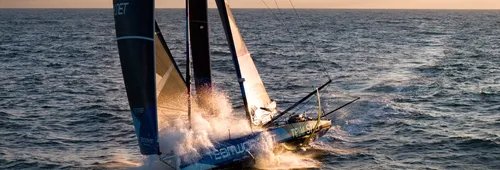



Six IMOCA teams will line up on the start line, bringing together campaigns at very different stages of development. Boris Herrmann's Malizia and Kojiro Shiraishi's new DMG MORI will race alongside the projects of Francesca Clapcich, Paul Meilhat and Oliver Heer. Although these campaigns are pursuing different objectives, the IMOCA calendar brings them together on the same racecourse—and, to varying degrees, they are all building towards November 2028. Departing from New York—a host city that will return to the Vendée Globe programme in June 2028 with the New York Vendée – Les Sables d'Olonne—the race will send the fleet into several days of intensive crewed sailing across the North Atlantic.
For the teams involved, this transatlantic race represents far more than another event on the calendar. It will provide an opportunity to log valuable offshore miles in genuine ocean conditions, in some cases aboard boats only recently launched, while immediately putting key design choices to the test offshore.
The objective will naturally be performance, but also to test onboard systems, assess how the boats perform across different points of sail and identify areas for improvement. Each new IMOCA design reflects a different philosophy of performance. Some favour larger, more powerful foils, while others prioritise a more versatile platform or ergonomics designed to make life easier for a solo skipper. Without revealing everything, this race will offer the first meaningful comparisons between the design philosophies that will eventually go head-to-head in the Vendée Globe.
A New Way to Prepare for the Vendée Globe
This evolution reflects a profound transformation within the IMOCA class. Although the Vendée Globe remains the ultimate solo challenge, preparing for it has become an increasingly collective endeavour. Naval architects, engineers, boat managers, meteorologists, performance specialists and sailors now work together over several seasons.
Crewed races have become a central part of that process. They allow boats to spend far more time on the water, maximise testing opportunities and rapidly confront technical decisions with the realities of offshore racing. In the space of just a few racing days, a team can generate a huge amount of data that might otherwise take weeks of training to collect.
For some campaigns, this crossing will also help strengthen team organisation, refine working methods and build stronger routines between the sailors and the technical team. Much of this work remains largely unseen, yet it has become an essential part of every modern IMOCA campaign.
Every Race Counts
A Vendée Globe campaign is not built solely aboard the race boat. It is forged race after race, transatlantic after transatlantic, through the accumulation of offshore miles, night-time manoeuvres and breakdowns repaired alone—or together. Every event on the IMOCA calendar, whether sailed solo, double-handed or fully crewed, adds another layer of experience for skippers, some of whom have yet to round Cape Horn.
Such is the paradox of today's collective preparation: it all leads to a moment when no one else will be on board. One skipper, one boat and one ocean. That definition has never changed—and it is precisely why the road to the start is so long. Everything patiently built by the team must ultimately be carried alone for two and a half months, without stopping and without outside assistance.
It also explains the diversity of today's projects. Some are aiming to win in Les Sables d'Olonne, while others are focused on realising the dream of completing a solo circumnavigation. That diversity is one of the strengths of the IMOCA fleet and has never prevented every skipper from sharing the same start line.
One Step in a Multi-Year Campaign
Preparing for the Vendée Globe no longer takes place only in the months leading up to the start. Campaigns now extend across several seasons, alternating between new launches, development phases, solo races and crewed competition. Every event serves a specific purpose: improving the boat, increasing reliability and ensuring that teams arrive at the major milestones better prepared and with greater confidence.
That is precisely where The Ocean Race Atlantic fits into the picture. The lessons learned during the race will guide technical developments over the coming months and contribute directly to the campaigns aiming to line up in Les Sables d'Olonne in 2028.
The First Glimpse of 2028
With more than two years still to go before the next Vendée Globe, this race will, of course, crown no favourite. Instead, it will allow several campaigns to reach an important milestone in their development: watching new boats make their racing debut, assessing the maturity of emerging projects and gaining insight into the technical directions chosen by different teams. That is precisely why it deserves close attention—because, beneath the surface, it is already telling part of the story of the 2028 Vendée Globe.